 Makeup Partner
 What Is Personal Color Analysis? A Complete Beginner's Guide
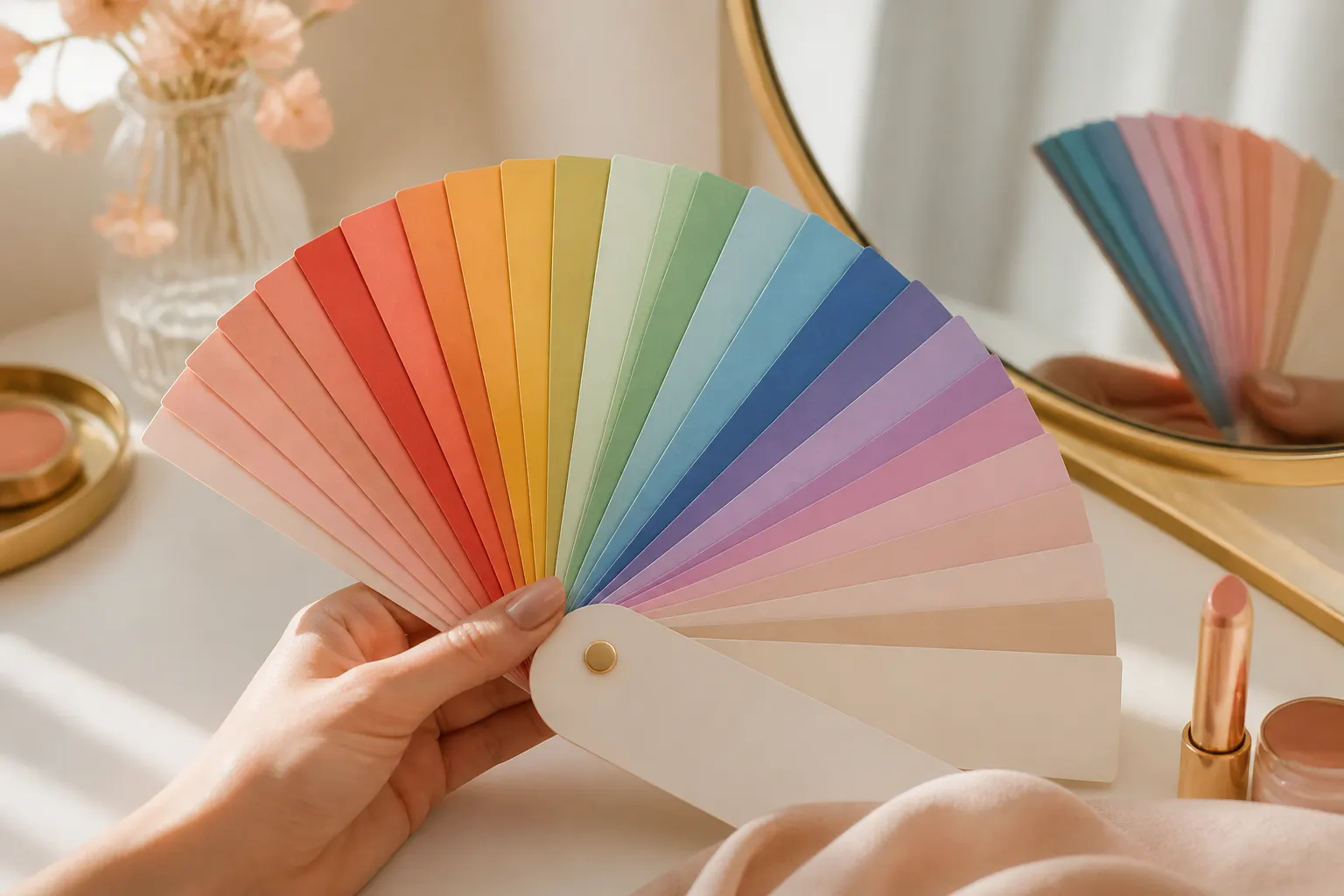
If you have ever held up two shirts and felt that one made your face glow while the other made you look tired, you have already experienced personal color analysis in action. It is the practice of identifying which colors harmonize with your natural coloring — your skin’s undertone, the depth of your eyes and hair, and the contrast between them.
Worn the right colors, your skin looks even, your eyes look brighter, and dark circles fade. Worn the wrong ones, the same face can look sallow, washed out, or older. The colors did not change your face — they changed the light bouncing back onto it.
Where personal color analysis comes from
The modern system traces back to color theory developed for art and design, popularized for personal styling in the 1980s with the book Color Me Beautiful. Over the decades it has been refined — especially in Korea and Japan, where “personal color” (パーソナルカラー) is now a mainstream beauty service. Today most analysts use a 4-season foundation that expands into 12 or 16 detailed types.
The three things that decide your colors
Every color season is really a combination of three measurable qualities:
| Axis | What it measures | The two ends |
|---|---|---|
| Undertone | Whether warm or cool tones flatter you | Warm (golden) ↔ Cool (rosy/blue) |
| Value | Whether you suit light or deep colors | Light ↔ Deep |
| Chroma | Whether you suit bright or soft colors | Vivid ↔ Muted |
Your personal color is just where you land on these three sliders. That is exactly how the Makeup Partner app scores you — on a warm/cool, light/deep, and vivid/muted axis — before naming your season and 16-type sub-type.
The four seasons
- Spring — warm, light, and clear. Fresh, golden, youthful colors like coral, peach, warm green, and ivory.
- Summer — cool, light, and soft. Elegant pastels like soft rose, powder blue, lavender, and dove gray.
- Autumn — warm, deep, and muted. Rich, earthy tones like terracotta, olive, mustard, and deep teal.
- Winter — cool, deep, and vivid. Bold, high-contrast colors like true red, emerald, royal blue, and pure white.
A quick way to remember it: Spring and Autumn are warm; Summer and Winter are cool. Spring and Summer are light; Autumn and Winter are deep.
From 4 seasons to 16 types
Two people can both be “Summer” yet look completely different — one delicate and pale, another cool and striking. That is why analysts split each season into sub-types. A 16-type system gives you four flavors of each season (for example Light Summer, Bright Summer, Muted Summer, and Cool Summer), so your palette is tuned much more precisely to your face.
Why it matters for makeup
Color analysis is not only about clothes — it is most powerful at the makeup counter. The “wrong” foundation undertone can make skin look gray or orange. A lipstick one step too cool can make teeth look yellow. When your lip, cheek, and eyeshadow shades match your season, your makeup looks intentional and your features come forward without extra product.
How to find your season
You can get a rough read at home using the tests in our guide on how to find your personal color and our breakdown of warm vs cool undertones. For a precise result, the Makeup Partner app runs an AI 16-type diagnosis from a short visual quiz and then builds a makeup palette around your exact result — including the shades to wear and the ones to skip.
Once you know your season, explore your colors in depth: Spring · Summer · Autumn · Winter.
Download Makeup Partner and get your AI personal color diagnosis.


Frequently asked questions
Is personal color analysis scientific?
It is based on real principles of color theory — undertone, value, and chroma — combined with how light reflects off your skin, eyes, and hair. While the seasonal labels are a practical framework rather than a lab measurement, the underlying contrast and undertone relationships are consistent and repeatable.
Can my personal color change over time?
Your underlying undertone stays the same for life, but your overall coloring can shift slightly with age, sun exposure, or hair color changes. Most people stay within the same season; only the sub-type may drift.
Do I have to dye my hair or change my wardrobe?
No. Personal color analysis is a guide, not a rulebook. Most people start by adjusting the colors closest to the face — lipstick, tops, and scarves — because that is where color has the biggest effect.